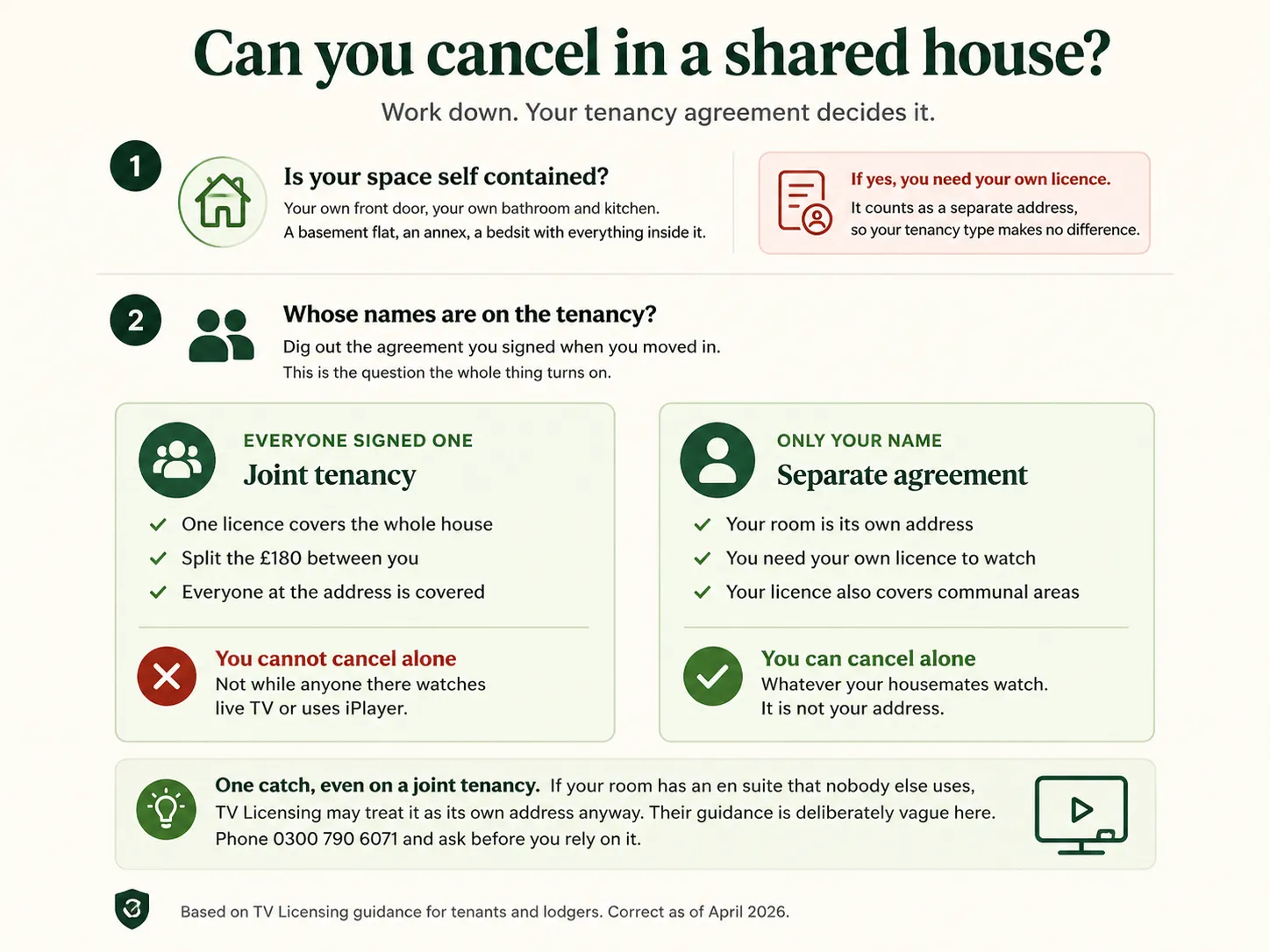
The person named on the licence is responsible for cancelling it, but whether you can cancel at all comes down to your tenancy. A joint tenancy signed by everyone means one licence covers the house, and you cannot cancel it on your own. A separate agreement for your room means your room is its own address, so you can cancel whatever your housemates do.
Most people who want to cancel a TV licence in a shared house get it wrong in one of two ways. Either they think a housemate who watches live football has trapped them into paying £180, or they think their own switch to Netflix means they can cancel. Both can be wrong, and both are expensive.
Who is responsible for the TV licence in a shared house?
The tenants are. Not the landlord.
TV Licensing is clear on this. The licence is the tenants’ responsibility unless the tenancy agreement says the landlord will provide it. A few all bills included lets do cover it. Most do not. Check yours rather than assume.
But “the tenants” does not mean everyone equally. It depends on how you signed.
The licence covers an address, not a person. Nobody is personally liable in the way people imagine. The question is which address your room belongs to, and that is what your tenancy decides.
Joint tenancy or separate agreement?
Dig out the document you signed when you moved in.
A joint tenancy has every housemate’s name on one agreement. You all signed the same piece of paper. You are jointly responsible for the whole property and the full rent.
A separate agreement is between you and the landlord alone. Your name is the only tenant name on it. Your housemates signed their own. This is normal in a house of multiple occupation, which is what most professional house shares and many student lets are.
That single difference changes everything below.
If you have a joint tenancy
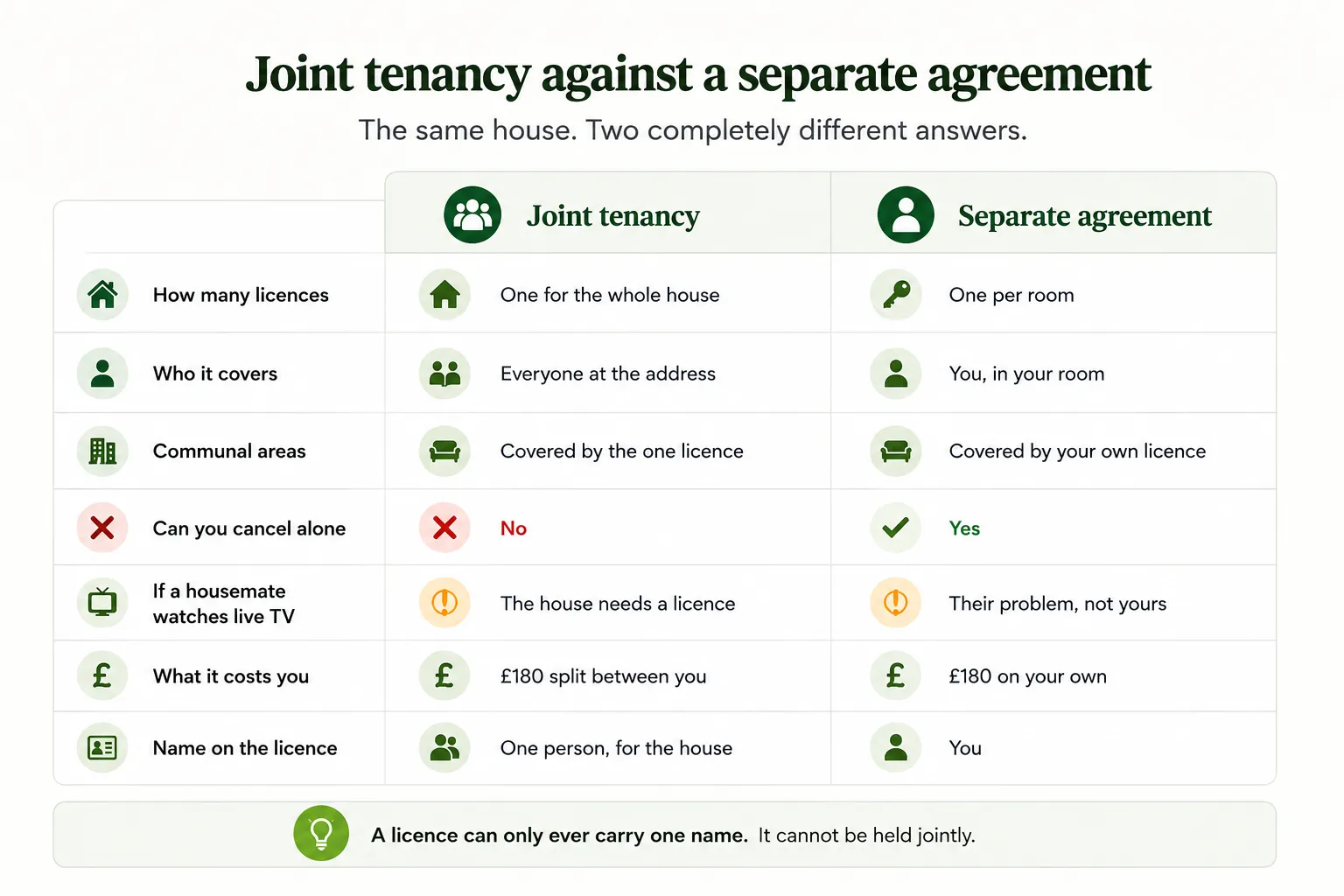
One licence covers the whole house. Every room, every device, everyone living there.
That is good news if someone still watches live TV, because you all share the cost of one £180 licence rather than paying separately. Split five ways that is £36 each a year.
It is bad news if you want out. You cannot cancel a TV licence that the house still needs. The declaration asks whether anyone at the address watches live TV or uses BBC iPlayer. If a housemate streams live football on a Saturday, the answer is yes, and signing to say otherwise is a false declaration.
Nothing physically stops you filling in the form. It is a criminal offence, and the maximum fine is £1,000 plus costs.
What you can do instead is stop paying for it. The licence has one name on it, and it is not a shared bill. Agree between yourselves who holds it and how the cost is split, the same way you would with broadband.
A TV licence cannot be in joint names. TV Licensing is explicit about this: it is a legal document and only one name goes on it. In a joint tenancy house, one person holds the licence and everyone else is covered by it.
This causes a real problem when that person moves out. The licence goes with them, not with the house. Whoever is left needs to take out a new one, or the address is unlicensed from that day. Sort this out before anyone leaves, not after.
If you have a separate agreement
Your room is treated as its own address.
You need your own licence if you watch live TV or use BBC iPlayer in your room. Your housemate’s licence does not cover you. Yours does not cover them.
And here is the part almost nobody tells you. You can cancel your TV licence on your own. What your housemates watch is irrelevant. The declaration is about your address, and on a separate agreement, your address is your room.
So if you have stopped watching live TV, and you have stopped opening iPlayer, you can cancel today and claim back every full month left. Your housemate can keep watching live football in the next room and it changes nothing.
That is the single most valuable thing on this page, and it is why finding your tenancy agreement matters.
The bit about communal areas
This catches people out, so it is worth being precise.
On a separate agreement, your own licence covers your room and the communal areas. The lounge, the kitchen, wherever the shared telly is.
The other side of that is uncomfortable. If you cancel your TV licence, you are no longer covered in the communal areas either. TV Licensing’s guidance for landlords says it plainly: tenants without a licence for their room are not covered in communal areas.
So the housemate who cancels a TV licence and then watches the live match on the lounge TV is not covered. Nobody mentions this, and it is exactly the sort of thing that turns a legitimate cancellation into an offence.
If you cancel, you stop watching live TV everywhere in that house. Your room, the lounge, all of it.
Two things that override your tenancy
Most of the time the tenancy answers it. Two situations change the answer regardless of what you signed.
Self-contained accommodation
If your part of the property is genuinely self-contained, you need your own licence whatever type of agreement you have. That means your own front door, your own bathroom and kitchen. A converted annex, a basement flat, a bedsit with everything inside it.
Self-contained means it is a separate address, so it needs its own licence.
Exclusive access to a bathroom
This is the one TV Licensing is quietest about, and it deserves more attention.
Their own guidance says that even on a joint tenancy, there may be other reasons you need your own licence, “such as whether or not you have exclusive access to a toilet or washing facilities.” Then they tell you to contact them to find out more.
That vagueness is not an accident. If your room has its own en suite that nobody else uses, your room starts to look like a self-contained unit, and TV Licensing may treat it as its own address even though you signed a joint tenancy.
If your room has an en suite and you are relying on a joint tenancy to avoid a second licence, phone them on 0300 790 6071 and ask directly. Get the answer in writing if you can.
Lodgers are a different case
If you are a lodger living with the homeowner, the rules change again, and the deciding factor is your relationship with them.
You are covered by the homeowner’s licence if you have a relationship with them. TV Licensing gives the examples: a family member, a common law partner, a nanny, an au pair, a housekeeper.
If you are simply a lodger paying rent to a stranger with no relationship beyond the tenancy, that cover does not apply, and you may need your own licence for your room.
Most people assume all lodgers are covered by the homeowner’s licence. They are not. The relationship is what does the work.
Students in a shared house
Everything above applies. Two extra points matter.
Your family’s licence at home does not cover your student room. There is one narrow exception, and it is narrower than most students think.
Your parents’ licence covers you at university only if all three of these are true at once:
- Your parents’ address has a valid licence
- You watch only on a device running purely on its own battery
- That device is not plugged into the mains and not connected to an aerial
Plug the laptop in to charge while you watch iPlayer and you are outside the exception. It is not enough that the laptop could run on battery. It has to actually be running on battery at the time.
The end of the tenancy is where the money is. Cancel the TV licence when your tenancy ends, because a licence bought in September and abandoned in June leaves three full months unclaimed. That is £45 you can have back, and most students never ask for it. Cancel using your tenancy end date, and claim the refund on the same form.
How to cancel your TV licence in a shared house
Once you know your tenancy type and you are sure you qualify, the process is the same as anywhere else.
Ask the whole house, not just yourself
Before you cancel a TV licence on a joint tenancy, remember the declaration covers everyone at the address. Ask each housemate directly whether they watch anything live, and whether they use BBC iPlayer for anything at all.
“I only watch Netflix” often turns out to mean “and iPlayer for that one documentary”. One yes and you cannot cancel.
On a separate agreement you only answer for your own room, so ask only yourself.
Find your licence number
Ten digits. It is on any letter from TV Licensing, at the top of a paper licence, in their emails, and on your bank statement next to the payment marked TV LICENCING.
Cannot find it? Phone 0300 790 6071 and they will look it up after a security check.
Fill in the No Licence Needed form
Go to tvlicensing.co.uk and look for “tell us you don’t need a TV Licence”. It is a public form. No account, no login.
Check your postcode twice. A wrong postcode is the most common reason a cancellation silently fails. The form looks like it worked, the record never matches your address, and the letters keep coming.
Use an email that is not linked to BBC iPlayer
The form asks for an email address. Give the one tied to your BBC account and you connect your cancellation to any future iPlayer sign in from that account.
Households have lost their no licence needed status this way, weeks later, because a housemate signed into iPlayer on a shared account.
Claim your refund on the same form
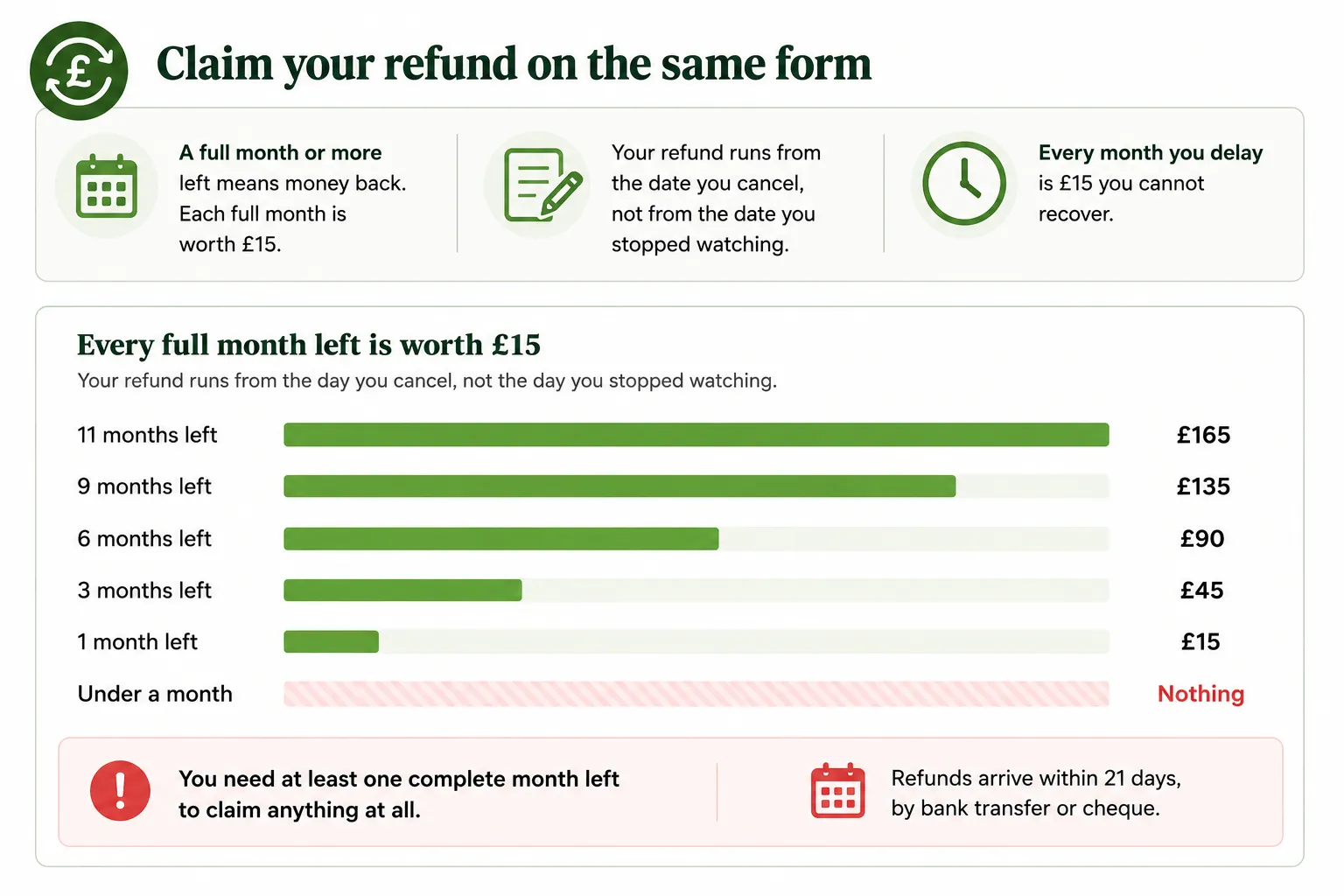
A full month or more left means money back. Each full month is worth £15.
Your refund runs from the date you cancel, not from the date you stopped watching. Every month you delay is £15 you cannot recover.
What if a housemate refuses to cooperate?
This comes up constantly and nobody writes about it, so here it is plainly.
On a separate agreement, it does not matter. You can cancel your TV licence without their permission, their signature, or their agreement. Your room is your address. Cancel yours and leave them to sort out theirs.
On a joint tenancy, you are stuck, and you should be. If someone at your address genuinely watches live TV, the address genuinely needs a licence. There is no clever way around that, and anyone telling you otherwise is inviting you to commit an offence.
What you can do is refuse to pay for it. The licence has one name on it. If the housemate who watches live TV is the reason the house needs it, that is a conversation about splitting a bill, not a licensing problem. Nothing obliges you to be the named holder or to contribute.
If they will not pay and will not stop watching, the person whose name is on the licence carries the risk. Make sure that is not you.
Never declare that nobody watches live TV when someone does. It is a false declaration and a criminal offence. The maximum fine is £1,000 plus costs, and the person who signed the form is the one in front of the magistrate. A housemate’s viewing is not worth a criminal record.
Common Questions
On a separate tenancy agreement, yes. You can cancel your TV licence on your own, because your room counts as its own address and your housemate’s viewing is irrelevant to your declaration.
On a joint tenancy, no. The licence covers the whole address, and if anyone there watches live TV or uses BBC iPlayer, the address needs a licence.
Check which agreement you signed before you do anything.
One joint tenancy signed by everyone means one licence for the whole house. Split the £180 between you.
Separate agreements mean one licence each, for anyone who watches live TV or uses iPlayer in their room.
Two exceptions override this. Self-contained accommodation always needs its own licence, and exclusive access to a bathroom may mean the same even on a joint tenancy.
No. TV Licensing is clear that a licence is a legal document and can carry only one name.
One housemate holds it and everyone at the address is covered. If that person moves out, the licence goes with them and whoever is left needs a new one. Sort that out before they leave.
Usually not. The licence is the tenants’ responsibility unless your tenancy agreement specifically says the landlord provides it.
Some all bills included lets do cover it. Read your agreement rather than assume, because an unlicensed address is the tenants’ problem, not the landlord’s.
Your own licence covers your room and the communal areas, so yes, while you hold one.
Cancel it and that cover goes too. TV Licensing’s guidance is explicit that tenants without a licence for their room are not covered in communal areas either. If you cancel, you stop watching live TV everywhere in the house, including the shared telly.
Only under a narrow exception. All three of these must be true: your parents’ address has a valid licence, you watch only on a device running purely on its internal battery, and that device is not plugged into the mains or connected to an aerial.
Charging the laptop while you watch iPlayer puts you outside it. If you have a TV in your room, or you watch while plugged in, you need your own licence.
Every full month left on the licence, at £15 a month. Six months left is £90.
You need at least one complete month remaining to claim anything. The refund runs from the date you cancel, not the date you stopped watching, so waiting costs you £15 a month.
Refunds arrive within 21 days, by bank transfer or cheque.
It depends on your relationship with them. A family member, partner, nanny, au pair or housekeeper is covered by the homeowner’s licence.
A lodger with no relationship beyond paying rent may need their own licence for their room. And if your part of the house is self-contained, with its own front door, bathroom and kitchen, you need your own licence regardless.
Before you cancel
Three things, in order.
- Find your tenancy agreement and work out which type it is. Everything follows from that.
- Ask everyone at the address about iPlayer, not just about live TV. It is the answer that catches people, because one old episode counts.
- Then cancel the TV licence, and claim the months you are owed. Waiting does not protect you. It just costs you £15 a month.
💡 Not sure whether you can cancel your TV licence? Answer three questions and find out.